


.png)
Restoring Flow: The Execution Revamp in T&D Projects
Case Summary
- 01
Challenges
- Severe desynchronization across functions such as design, ROW, foundation, erection, and supply, each working independently.
- Conflicting KPIs where teams optimized for local targets (for example, towers fabricated or foundations completed) instead of overall project flow.
- Reactive site decisions where field teams shifted locations based on ease of access, breaking planned continuity.
- Fragmented monitoring with progress tracked through multiple spreadsheets, preventing early detection of misalignment.
- Weak coordination as meetings focused on review rather than problem-solving, and no shared view of sequence or priorities existed.
- 02
Our Work
- Introduced the Focus & Finish execution system to drive synchronization across all functions.
- Developed integrated batch-level plans linking design release, material dispatch, ROW clearance, and foundation readiness.
- Replaced numeric KPIs with outcome-based metrics such as the number of stringing-ready sections and velocity (planned versus actual duration).
- Conducted weekly cross-functional reviews focused on conflict resolution and sequence alignment.
- Enabled data-driven visibility to prioritize work fronts for continuous stringing and faster energization.
- 03
Results
- KPTL implemented the approach across Africa, Ukraine, Bhutan, and India and achieved a 30–40% improvement over AOP targets.
- GR Infra adopted the model for all power transmission and distribution projects from September 2025 onward.
- Improved velocity and predictability of project completion through synchronized execution flow
T&D Projects Background
India’s transmission network is expanding rapidly to meet the country’s growing energy demand. Numerous companies are entering this sector, increasing both competition and project complexity.
A transmission line typically consists of a series of towers spaced approximately 300–400 meters apart. These towers are categorized as suspension towers and angle towers:
- Suspension towers are lightweight structures used along straight stretches of the line.
- Angle towers are heavier, designed to withstand the additional stresses that occur where the line changes direction.
Angle towers are further subdivided according to the degree of deviation at each turn. Tower height and shape are adjusted using body and leg extensions to account for ground elevation and sag requirements. For river, road, or line crossings, towers with larger extensions are used.
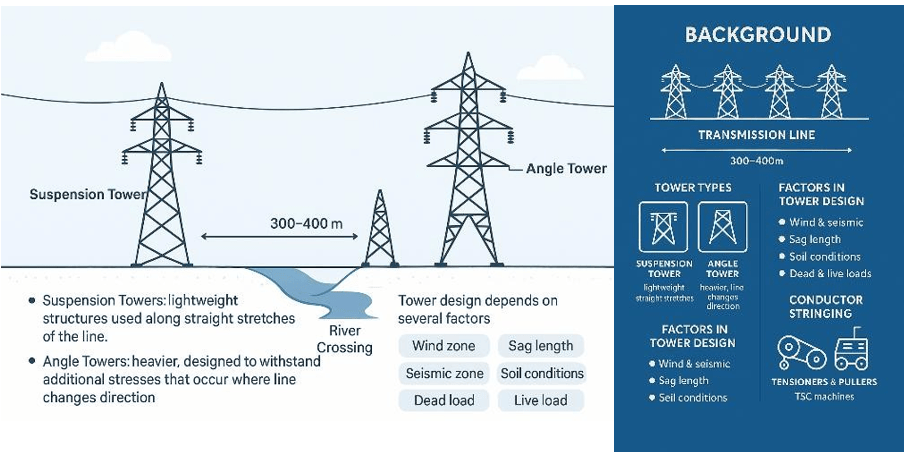
Tower design depends on several factors, including wind and seismic zones, sag length, soil conditions, and both dead and live loads. Conductor stringing is the process of laying the conductors & is typically performed between two angle towers (forming a “section”) using a set of specialized machines such as tensioners and pullers, collectively known as TSC machines. Because TSC deployment is expensive, projects aim to maximize productivity by ensuring continuous sections are ready for stringing.
Experienced transmission line companies often maintain a library of tower designs developed for different site conditions. New entrants, however, must create these designs from scratch as they build their own design base over time.
Project Execution Approach
In a typical transmission line project, suspension towers account for about 60–70% of the total towers. Planning focuses on enabling the release of continuous sections for conductor stringing, as this minimizes idle time for TSC machinery and reduces overall project cost.
When a project requires new tower designs, the execution strategy prioritizes sections with the highest proportion of suspension towers and the most commonly used angle towers at each end. This allows early progress using standard designs while minimizing initial design workload.
Sections involving crossings, forest areas, or special structures are scheduled later, as they often require additional approvals, design modifications, or coordination with external agencies.
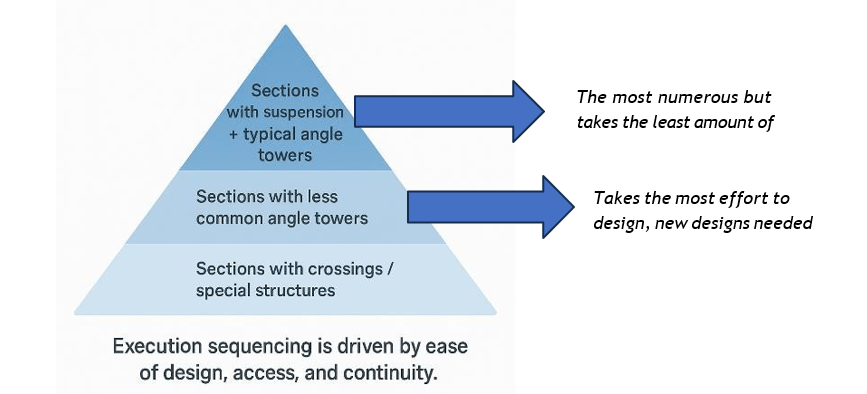
Based on this rationale, tower construction is generally prioritized in the following sequence:
- Sections with suspension towers and the most typical angle towers at both ends.
- Sections with suspension towers but less common angle towers at one or both ends.
- Sections involving river crossings, other transmission lines, highways, or special structures.
Contractors responsible for foundations and erection also prefer continuous stretches, as these reduce mobilization and logistical costs. Thus, alignment of design, right-of-way (ROW), and material availability is essential to maintain steady project momentum.
Emergence of Desynchronization
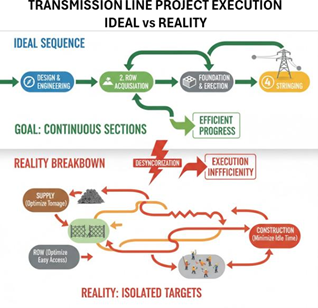
Despite careful planning, desynchronization often arises in transmission line projects due to misaligned priorities among stakeholders. Each function tends to optimize its own performance metrics rather than the overall project objectives, creating execution inefficiencies.
For instance, tower suppliers typically prioritize fabricating and delivering “basic body” components without extensions to maximize billing based on tonnage. Meanwhile, the Right-of-Way (ROW) team secures access to locations where compensation demands are lower or terrain is more accessible, violating the planned construction sequence sometimes.
Similarly, when disruptions occur at a specific foundation site, foundation gangs shift to the next available location to minimize idle time and mobilization costs. This reactive approach often breaks the planned continuity of work fronts.
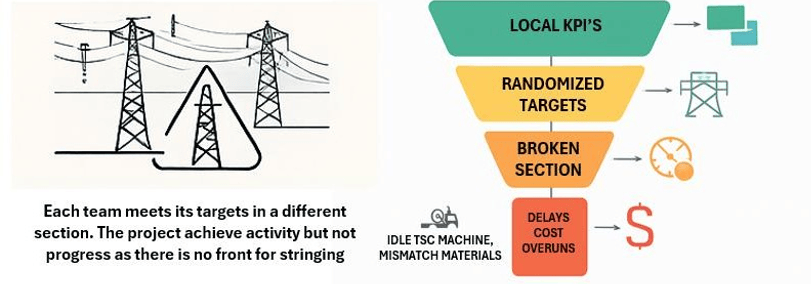
At the management level, monthly performance targets further compound the issue. Review meetings focus heavily on numerical achievements, such as towers erected or foundations completed, rather than on strategic progress such as the number of stringing-ready sections. As a result, project teams prioritize short-term completion figures over long-term synchronization of activities.
The outcome is a project that meets isolated targets for individual departments but falls short in generating the continuous, fully prepared fronts necessary for efficient stringing and timely completion.
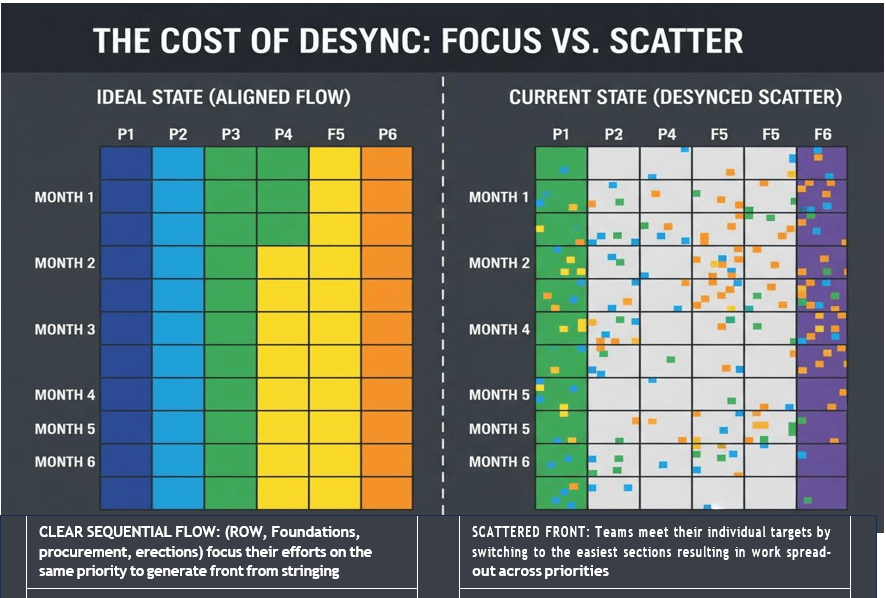
Root Cause Analysis
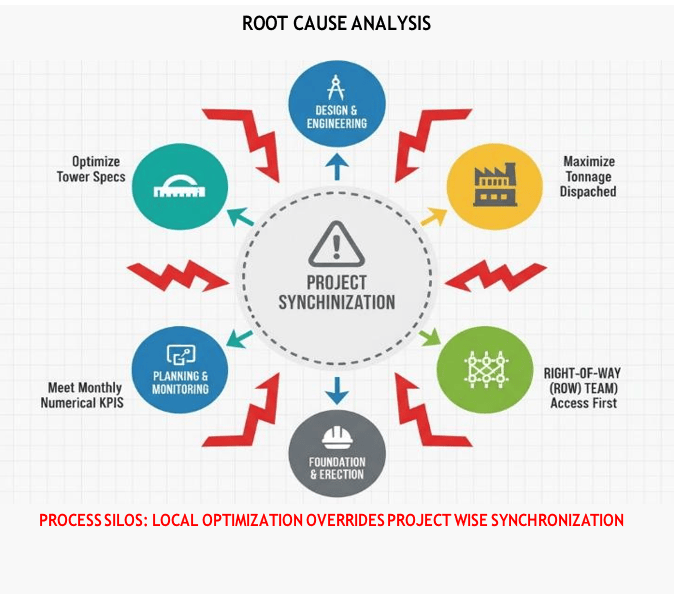
The desynchronization observed in transmission line execution is not the result of isolated mistakes but of systemic misalignment among project stakeholders. Several interconnected factors contribute to thisbreakdown:
- Conflicting Functional Objectives
- Each team: design, procurement, ROW, foundation, erection, and stringing operates under separate performance metrics.
- While these targets drive accountability, they often conflict with overall project sequencing. For example, suppliers focus on dispatch volume,while construction teams need specific tower types and extensions in a particular order.
- Target-Driven Management Culture
- Monthly review cycles emphasize numerical progress (e.g., number of towers erected or foundations completed).
- These “KPI pressures” incentivize short-term gains, leading teams to pursue easily achievable quantities instead of strategic sections that advance the project’s true critical path.
- Reactive Field Decision-Making
- Field teams adjust plans on the ground based on immediate accessibility, material availability, or workforce utilization.
- Such reactive behaviour, though operationally efficient in the short term, disrupts coordination between design, ROW, and erection fronts.
- Lack of Integrated Planning and Monitoring Tools
- Project monitoring is often fragmented across spreadsheets and departmental trackers.
- The absence of a centralized, dynamic project interface prevents early detection of sequence mismatches between tower supply, ROW clearance, and site readiness.
- Insufficient Communication Channels
- Coordination meetings are typically review-oriented rather than problem-solving sessions.
- Without cross-functional collaboration, teams are unable to realign when deviations occur, leading to further execution drift.
Overall, the root cause lies in process silos where local optimization overrides project-wide synchronization.
Key Learnings and Recommendations
The case illustrates how even technically sound planning can falter when execution priorities are misaligned. Achieving synchronization in transmission line projects requires both structural and behavioural changes across the project organization.
Key Learnings
- Local efficiency does not equal project efficiency. When each function focuses on meeting its own numbers, overall progress suffers.
- Continuity of execution fronts not isolated activity counts should be the main indicator of progress.
- Cross-functional alignment between design, supply chain, ROW, and construction is essential to convert planning logic into field reality.
- Early detection of sequence mismatches can prevent costly rework and resource under utilization.
An Alternate Approach to Execute Projects - "Focus & Finish"
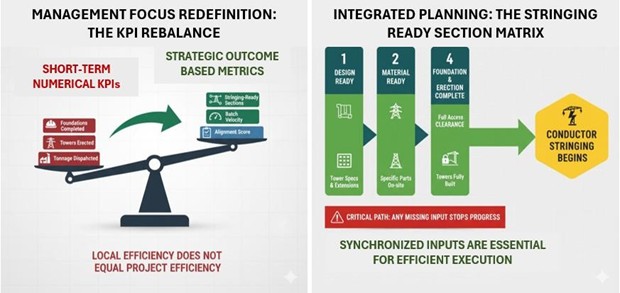
- Integrate Planning Across Functions
- Develop a unified batch level project plan linking design release, material dispatch, ROW clearance, and foundation readiness. This ensures that all teams work toward the same execution sequence.
- Redefine Performance Metrics
- Replace purely numerical KPIs with outcome-based indicators such as number of stringing-ready sections or Velocity of batches i.e. planned duration/actual duration.
- Enhance Cross-Functional Communication
- Conduct weekly coordination meetings focused on resolving sequence conflicts rather than reviewing target achievements.
Conclusion
Desynchronization in transmission line execution stems from fragmented planning, conflicting performance drivers, and limited cross-functional coordination. By reorienting management focus toward synchronization, outcome-based metrics, and integrated monitoring, transmission companies can significantly improve project efficiency, reduce delays, and achieve faster energization.
Results/ Implementation in T&D
- KPTL Implemented this alternate approach of project execution in transmission line projects across Africa, Ukraine, Bhutan and India & they exceeded their AOP targets by 30-40%
- GR Infra has started implementation for their entire power transmission distribution projects in Sep-25.


Contact us to find out more
Our Customer Service Teams have hundreds of Industry specific studies to draw from ... get in touch if you want to see something specific to your needs, or simply explore how we can deliver Radical Results for you.

Pashan Sus Road, Pashan Pune. MH- 411021 IN